
In August, the top BRICS leaders at the grouping's summit in Johannesburg approved a proposal to admit six countries, including Argentina, into the bloc with effect from January 1.

The US "Indo-Pacific Strategy" is bound to be a failed strategy, Wang said in the comments posted by the Chinese foreign ministry on its website.

On a mission to cool soaring bilateral tensions, United States Secretary of State Antony Blinken on Sunday held extensive talks with his Chinese counterpart Qin Gang on a range of issues, including the Taiwan issue and the Ukraine war.

The banned Baloch Liberation Army (BLA) claimed responsibility for the attack, saying the blast was a suicide attack targeting a convoy of Chinese engineers and investors leaving the Jinnah International Airport.

The trigger that led Japan and the Philippines to ink the deal was because of the deteriorating security situation in the South China Sea. China's coast guard increased the frequency and intensity of incursions into Philippine waters, provoking the Philippines to take countermeasures to deter China, explains Dr Rajaram Panda.
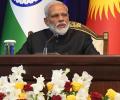
Modi hits out at trade protectionism and calls for a rule-based, transparent, anti-discriminatory, open and all inclusive WTO-centred multilateral trading system focused so that the interests of every country specially the developing ones can be taken care of.

Ahead of a key global summit on atomic security, China on Tuesday defended its nuclear cooperation with Pakistan as "mutually beneficial" and in accordance with international safeguards.

Prime Minister Narendra Modi urged CEOs of US majors to take advantage of India's growth story as the country is making all efforts to become the third largest economy of the world in his third term. India is currently the fifth largest economy of the world after the US, China, Germany and Japan with a GDP of around $3.9 trillion. India has been the fastest growing large economies of the world with GDP growth rate of over 7 per cent for the last three consecutive years.

The United States-China Summit meeting concluded at a sprawling mansion in Woodside, California with Presidents Joe Biden and Xi Jinping agreeing to work towards ensuring that the differences between the two countries remain manageable and the relations do not derail.

He suggested evolving specific plans for cooperation with the 10-memeber grouping in key areas of maritime security, counter-piracy and humanitarian and disaster relief.
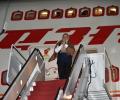
Attending the Nuclear Security Summit for the first time, Modi is expected to lay out his vision of securing nuclear weapons.

China has signalled that it will prevent India from assuming leadership of the Global South, observes Ambassador T P Sreenivasan.

It was the second time in the last three days that India asserted that the relationship with China depends on the resolution of the pending issues in eastern Ladakh.

With Lok Sabha elections months away, the visits are vital politically as these would showcase Modi's standing as a world leader to the home electorate.

'Given China's past behaviour and their territorial claims, should we be sceptical regarding China's willingness to adhere to these agreements fully? The answer is yes.' 'As Ronald Reagan famously said in the context of the SALT talks, 'Trust, but verify!' India should also do the same.' 'This has already begun with foot patrolling, drones, satellite imagery and so on. India's military deployment did mirror China's and will continue to do so in the future.'

Johnson also reiterated his plan to visit India ahead of the G7 summit, after a scheduled visit for Republic Day this month was called off due to the coronavirus crisis.

In a face saver, SAARC countries signed a framework agreement on cooperation in power sector but failed to finalise the much-awaited motor vehicle and railway pacts

Both Putin and Zelenskyy have invited the prime minister to visit Russia and Ukraine respectively after the Lok Sabha elections, sources said, adding they see Modi as a "peacemaker".

It's time India re-visited its Western alliances for the attitude and approach that the West reserves for the nation when it comes to security cooperation of the kind that they might not have visualised outside of China, India's bug-bear, asserts N Sathiya Moorthy.

The Shanghai Cooperation Organisation is very much aligned with the foreign policy priorities of the Modi 2.0 government, says Sana Hashmi.

India is a great power that determines its national interests and chooses its partners, Russian Foreign Minister Sergey Lavrov has said, describing as "completely unjustified" the "enormous pressure" on New Delhi due to its energy cooperation with Moscow.

India on Monday expelled six Canadian diplomats and announced withdrawing its high commissioner and other 'targeted' officials from Canada after strongly dismissing Ottawa's allegations linking the envoy to a probe into the killing of Sikh extremist Hardeep Singh Nijjar, in a major downturn in already frosty ties between the two nations.
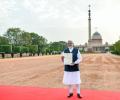
A multi-layer security arrangement involving five companies of paramilitary personnel, NSG commandoes and snipers have already been deployed around the Rashtrapati Bhawan. Drone cameras have also been put into service.

The development comes after four of the eight member states -- India, Afghanistan, Bhutan and Bangladesh -- decided to pull out.

Modi is visiting Uzbekistan at the invitation of President of Uzbekistan Shavkat Mirziyoyev.

'Are we to believe that coordinated moves by the Canadian and US authorities are no longer taking place?', asks Ambassador M K Bhadrakumar.
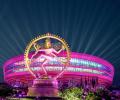
The first summit in South Asia, it will host the largest delegation of 43 heads of State and government as well as the heads of international organisations.

At the invitation of Prime Minister Narendra Modi, President Xi Jinping and PM Shehbaz Sharif will attend via video conference, the 23rd meeting of the Council of Heads meeting of the SCO on July 4.
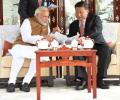
"The two leaders have also mapped out concrete measures to implement such kind of consensus," she said.

India said a new mechanism will be set up for issues relating to trade and investment.

The Jaishankar-Wang talks came amid the dragging border row in eastern Ladakh that entered its fifth year in May.

The declaration said the SCO leaders reaffirmed their commitment to peaceful settlement of disagreements and disputes between countries through dialogue and consultations.

Modi held talks with Abe after arriving in the Laotian capital to attend the Association of Southeast Asian Nations-India and the East Asia summits that will take place on Thursday.

The two leaders shook hands and exchanged pleasantries at the end of the media briefing which was addressed by Chinese President Xi Jinping. China is the host and chair of the SCO.

India, along with Pakistan, is set to be inducted as full members into the bloc, which mainly deals with issues relating to security and defence.
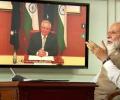
The Mutual Logistics Support Agreement will allow militaries of the two countries to use each other's bases for repair and replenishment of supplies besides facilitating scaling up of overall defence cooperation.

Modi said New Delhi has emphasised on dialogue and diplomacy along with restraint to deal with the situation arising out of the Hamas-Israel conflict.

As India's stock rises, the resolution of the border row may become even more difficult, warn Harsh V Pant and Kalpit Mankikar.

'From Doklam to Wuhan and the return of the India-China relationship to its previous equilibrium is indeed a major contribution of President Xi and PM Modi. Without any doubt they deserve the kudos for their sagacity and their wisdom,' says Ambassador Gautam Bambawale, India's envoy to China during the Wuhan summit.
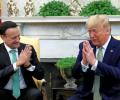
The decision comes as countries around the world seal their borders and ban travel to stop the fast-spreading COVID-19 pandemic that has claimed over 9,000 lives so far.
 © 2026 Rediff.com - Advertise with us - Disclaimer - Privacy Policy - Sitemap - Feedback - About us - Terms of use - Grievances